Showing posts with label traffic. Show all posts

Sunday, April 25, 2010

Bicycle Rules For Motorists TDH

1. A bicycle is a vehicle and any person riding a bicycle has all of the rights
and responsibilities as a driver of a vehicle.


2. Bicyclists are required to ride as far right in the lane as possible only
when the lane can be safely shared by a car and a bicycle, side by side.

Even then, there are certain conditions that allow a bicyclist to take the full
lane such as:


a. The person is overtaking and passing another vehicle proceeding in
the same direction.


b. The person is preparing for a left turn at an intersection or onto a private
road or driveway.


c. There are unsafe conditions in the roadway such as fixed or moving
objects, parked or moving vehicles, pedestrians, animals, potholes, or
debris.


d. The lane is of substandard width making it unsafe for a car and a bicycle
to safely share the lane side by side. When this is the case, it is best
for the cyclist to take the full lane whether riding single file or two
abreast.


3. Bicyclists are not restricted to the right lane of traffic. One-way, multi-
laned streets are one example. Another instance is when the bicyclist is
changing lanes to make a left turn.
The bicyclist should follow the same path
any other vehicle would take traveling the same direction.


4. Motorists should merge with bicycle traffic when preparing for a right
hand-turn. Avoid turning directly across the path of bicycle traffic.

Common Motorists Mistakes

1. The most common motorist caused car-bicycle collision is a motorist
turning left in the front of oncoming bicycle traffic. Oncoming bicycle traffic is
often overlooked or its speed misjudged.


2. The second most common motorist caused car-bicycle collision is a
motorist turning right across the path of the bicycle traffic. The motorist
should slow and merge with the bicycle traffic for a safe right-hand turn.

3. The third most common motorist caused car-bicycle collision is a
motorist pulling away from a stop sign and failing to yield right-of-way to bicycle
cross traffic. At intersections, right-of-way rules apply equally to motor
vehicles and bicycles.


TEXAS DRIVERS HANDBOOK
TEXAS DEPARTMENT OF PUBLIC SAFETY
Revised October 2008

Friday, April 23, 2010

Part of Chapter 13 of the Texas Driver Handbook

COMMON MOTORIST MISTAKES THAT BICYCLE RIDERS SHOULD
KNOW


1. The most common motorist caused car-bicycle collision is a motorist
turning left in the face of oncoming bicycle traffic. Oncoming bicycle traffic is
often overlooked or its speed misjudged.

2. The second most common motorist caused car-bicycle collision is a
motorist turning right across the path of the bicycle traffic. The motorist
should slow down and merge with the bicycle traffic for a safe right-hand
turn.


3. The third most common motorist caused car-bicycle collision is a
motorist pulling away from a stop sign, failing to yield right-of-way to bicycle
cross traffic. At intersections, right-of-way rules apply equally to motor vehicles and bicycles.


Page 13-3

Sunday, November 15, 2009

The Steps of the Dance

Most of us use the roadway system as we do our common everyday electronics—we tend to take for granted what makes them function. There is a practical elegance to the way our streets and roads operate, and a greater awareness of it would make us all more civil, safer and cooperative citizens.

There are two overarching principles that are the basis of our uniform traffic code. These two principles lead inevitably to six basic rules of traffic that govern nearly all of our daily traffic experience.

While they are known subconsciously and perhaps intuitively, most folks who operate motor vehicles on our nations roadways are unfamiliar with this more formalized expression of these principles. Even so, they operate by them when following the traffic laws and the traffic control devices found on their way.

Here are the arch-principles and the six basic laws of traffic that follow from them.

Travel to the right


Early roads had no lanes, and the width of the entire road could be quite narrow. It became customary in the United States that traffic would stay to the right to reduce chaos, perhaps following established maritime law. Other countries developed a stay to left tradition. From this arch-principle flows these two basic laws of traffic;

1) Always operate on the right-hand side of the roadway, not on the left.

2) When approaching an intersection, position yourself according to the direction in which you want to go. Right-turning drivers are at the right, left-turning drivers are at the left, close to the center of the roadway, and straight-through drivers are between them, as conditions allow.
We practice this every time we take to the public road, but few of us have been exposed to the formalized stating of it. The second basic rule as stated presumes multiple lanes in each direction, but even on streets without lanes we turn right from close to the curb and turn left from the center area of the street.

First come, first served

The public space is a finite resource. How is it to be distributed to the public in a fair way? This arch-principle addresses that. It epitomizes the meaning of public in "public road". Everyone has the right to travel in the public space, and they have a right to a reasonable amount space in front of them, behind them and to their sides in order to travel safely.

3) When two operators are traveling in the same direction in a travel lane, the one behind the other must leave enough space to avoid colliding with the operator in front of him.

Most of us today think of this rule as part of the driver’s prime directive; "Thou shalt not hit things". But it is also a fundamental expression of the right of way on public roads. One cannot simply crash into slower traffic, we must overtake them when it is safe and to do so with due care.

4) When approaching a road that is larger than the one you are on, or carries more traffic, or faster traffic, or is protected by a stop or yield sign, you must yield to traffic on that roadway. Yielding means looking left and right until you see that no traffic is approaching so closely as to constitute a danger.
A person traveling down a road has "the right of way", meaning you can’t just pull out in front of someone and put them in danger. We must allow him access to a reasonable amount of space in front of him to avoid a collision. We operate under this principle all the time, and we have an expectation it will be observed by folks pulling onto the road in front of us. The law grants us the right of way, and the lawful operator respects it.

5) When intending to move your line of travel either left or right upon the roadway, you must yield to traffic in the new line of travel. Yielding means looking in front and behind until you see that both directions are clear, that there is no traffic approaching so closely as to constitute a danger.

We have the right to the space we are occupying within a lane of travel, and it should not be encroached upon.

6) When operating between intersections, drivers position themselves according to their speed relative to other traffic. Parked vehicles are next to the curb, slow drivers are next to them, while the fastest traffic is to the left, next to the centerline as conditions of the roadway allow.

This is the speed positioning rule. It implies that overtaking shall be done on the left, and passing on the right is discouraged. The fastest traffic should return to the right lanes when slower traffic has been cleared.

These six basic rules interact with one another. For example, it is unlawful in many states to change lanes within an intersection. Someone entering the roadway at the intersection may proceed into the lane someone is merging into, inadvertently violating his right of way.
The uniform traffic code, adopted in whole -or with few exceptions to the body of it- by the various states means that a person driving into an unfamiliar place anywhere in the country will be able to operate with little difficulty. The local streets and their working function will seem normal to him.

This system functions just fine without an explanation of the underlying principles; As a result, most people have never thought about, or clearly understood them, as long as the other traffic around them has similar operational characteristics.

What do you mean by traffic, anyway?


Our society has seen fit to divide "traffic" into three basic types; Pedestrians, human powered vehicles and motor vehicles. The vehicle laws make some exceptions and special rules for each class to reflect their differing operational characteristics on our public roads.

Motorists and cyclists must yield right of way to pedestrians crossing the roadway at a crosswalk, for example. [3] Cyclists are often restricted from using limited access highways because they are not capable of maintaining the minimum speed required for safe operation. People who wish to operate motor vehicles on the public way are subject to licensing and insurance requirements due to the potential damage and injury that the misuse of such vehicles can do to others.
Because motor vehicles are the overwhelming majority of traffic on public roads, people tend to think of "traffic" as only consisting of automobiles and the like. But most states define what they mean by "traffic" in the highway codes to include a much broader variety in modes of travel than just motor vehicles. (Because I am a citizen of Texas, and as I am most familiar with their codes, I will now be speaking less generally and more specifically of the Texas Transportation Code. [TTC]) The TTC defines "traffic" as; "pedestrians, ridden or herded animals, and conveyances, including vehicles… singly or together while using a highway for the purposes of travel." [1]

I doubt most Texas drivers think of horse drawn wagons when they think of traffic! And yet, the law recognizes and allows for a horse drawn wagon to have the same right of way as an automobile, that is, a reasonable amount space in front of them, behind them and to their sides in order to travel safely on the public road.

The traffic laws apply to all these different road users as the nature of their vehicle allows. [2]
Thwarted expectations lead to anger.


Perhaps because motor vehicles are the most common form of traffic on public streets today, there is a popular expectation that people ought to proceed at or above the speed limit regardless of prevailing conditions.

The necessity of putting a limit on the maximum speed one can travel is almost entirely a creation of the automobile itself. As automobiles became more powerful, all societies determined that speed limits were necessary to protect the innocent public from the destructive power of such fast heavy vehicles. While an out-of-control bicycle can cause severe injury, it can never approach the damage potential of a 4,000 lb. vehicle.

But a maximum speed limit is just that; A cap on how fast a motor vehicle can operate on a public road in perfect conditions, for the purpose of public safety.

Certainly upon a moments reflection, one can describe dozens of conditions that would prevent operating at maximum speed; Inclement weather, poor road surface, blind corners and hills, animals on the roadway, construction activity, slow traffic, trains at railroad crossings, emergency vehicles and even traffic lights! These conditions and more inhibit our forward progress endlessly.

So is it any wonder that a motorist going about with an expectation of traveling at top speed is constantly frustrated and annoyed? Is not this foolish expectation a source of his angst?

This anger often finds a scapegoat when the impedance is non-standard traffic, like a cyclist. A few of our fellow citizens take advantage of their position of power and anonymity inside their automobile to bully and harass lawful travelers on our public roads. Incivility abounds.

Right of way and impeding others.

Not understanding the six basic rules leads to a misunderstanding of the difference between lawful impedance and unlawful impedance.

As we go about our daily travels, we are impeded at every turn. That is, someone using the public road manages to be in the way of faster traffic, forcing us to slow down to avoid hitting them. Nearly all of these conflicts are a lawful interruption of your forward progress. In fact, most traffic conflicts are so common we hardly consider them an impedance at all! That is, as long as the impedance fits your definition of traffic!
If it is an automobile in the lane ahead of you waiting for oncoming traffic before executing a left turn that is causing you to slow down and even stop, it is no big deal. But if it is a cyclist in the lane ahead of you, well, that is a horse of a different color! "Doesn't he know that the roads are designed for cars!" is an oft heard complaint. (Actually, most roads are designed so that trucks can operate on them. Should we be glad truckers deign to allow us to drive our cars on them?)

All operators of vehicles have the same rights and duties on public streets. Parking a vehicle in a travel lane would be against the law, (unlawfully impeding traffic) unless the vehicle was broken down and unable to move out of the way. Traveling unreasonably slowly can also be an illegal impedance, if the vehicle is capable of keeping up with the faster traffic around him. And this is the notion that creates allot of the animosity toward bicycles: Aren’t bicycles impeding traffic because they are moving so much slower than other traffic?

If the cyclist is traveling at a reasonable pace for a bicycle, then it not an illegal impedance. He is operating a slow vehicle, and one that drivers of fast vehicles must give way to as they would to any other slow traffic. You know, buses, farm equipment, street sweepers and the like. The automobile operator has the obligation to respect the cyclist’s right of first come first served, just as he would the driver of any other slow vehicle.

Doesn’t the operator of a bicycle have an obligation to stay out of the way of faster traffic?
Sometimes, but rarely. Most states require cyclists to ride as close to the edge of the roadway as practicable. (Yes, practicable!) This is a reflection of the unique characteristics of the narrow profile of a bicycle. It is the only vehicle on public roads that is required to share a lane side-by-side with automobiles in some circumstances. And it is the only vehicle that is directed by law as to where in the travel lane he must operate.

But because operating within the same travel lane side-by-side with faster traffic is often neither safe nor practicable, the law has made exceptions to those rules. In Texas, those exceptions include, but are not limited to, a condition of the roadway, pedestrians in the lane, surface hazards, parked cars, and if the travel lane is less than fourteen feet wide. [4]

It may not be obvious to the motorist why the cyclist is not operating closer to the edge of the roadway than he is, but that is really immaterial to his performance of his duty to use due care. If there is not enough room to pass a cyclist with reasonable safety within the lane, the faster traffic must change lanes to pass him. (It is illegal in Texas to straddle the lane.) [5]

One or more exceptions to the far-to-right rule is present on almost every road in Texas.

Motorists will often get extremely angry when two cyclists are riding abreast in a traffic lane, even though the travel lane is too narrow to allow a car and a bicycle to travel side-by-side. Before slandering the character of the cyclists in front of you, please consider whether you would be able to pass a solo cyclist without changing lanes.

Some have told me that a cyclist must ride on an improved shoulder alongside a roadway if one is available, but a careful reading of the statutes shows that this is false in Texas. A cyclist is permitted to ride on an improved shoulder, but this is not mandatory. [6] In fact, it could be argued that doing so removes a cyclist from many legal obligations and protections. [7] I am of the opinion that riding on the shoulder is more dangerous than operating in the roadway. [8]

Access to the roadway space is allocated on a first come, first served basis for every form of traffic. So if you see a cyclist in the travel lane ahead of you, don’t be afraid to touch your brakes. Calm down, it is really not that hard to pass a cyclist safely! Just treat them as you would any other slow moving vehicle. With but a moments delay, you will be speeding off to the next traffic conflict or red light in no time!

Acknowledgments. I am, as it has been said, standing on the shoulders of giants! The basic principles spring from John Forester, but I have added to his list of five the one about following distance.

Any clarity I have on traffic dynamics and impedance must be credited to Mighk Wilson, Keri Caffrey and Herman May who have done most of the heavy lifting for me.

Thanks also to P.M. Summer and everyone on the ChainGuard mailing list who have unlocked many mysterious traffic engineering concepts for me.

Footnotes:

[1] Sec. 541.301.  TRAFFIC.  In this subtitle "traffic" means pedestrians, ridden or herded animals, and conveyances, including vehicles and streetcars, singly or together while using a highway for the purposes of travel.
Sec. 541.201. (23)  "Vehicle" means a device that can be used to transport or draw persons or property on a highway.

[2] Sec. 545.002.  OPERATOR.  In this chapter, a reference to an operator includes a reference to the vehicle operated by the operator if the reference imposes a duty or provides a limitation on the movement or other operation of that vehicle

[3] Sec. 552.003. PEDESTRIAN RIGHT-OF-WAY AT CROSSWALK. (a) The operator of a vehicle shall yield the right-of-way to a pedestrian crossing a roadway in a crosswalk if: (1) no traffic control signal is in place or in operation; and (2) the pedestrian is: (A) on the half of the roadway in which the vehicle is traveling; or (B) approaching so closely from the opposite half of the roadway as to be in danger.(b) Notwithstanding Subsection (a), a pedestrian may not suddenly leave a curb or other place of safety and proceed into a crosswalk in the path of a vehicle so close that it is impossible for the vehicle operator to yield. (c) The operator of a vehicle approaching from the rear of a vehicle that is stopped at a crosswalk to permit a pedestrian to cross a roadway may not pass the stopped vehicle.

Sec. 552.005. CROSSING AT POINT OTHER THAN CROSSWALK. (a) A pedestrian shall yield the right-of-way to a vehicle on the highway if crossing a roadway at a place: (1) other than in a marked crosswalk or in an unmarked crosswalk at an intersection; or (2) where a pedestrian tunnel or overhead pedestrian crossing has been provided. (b) Between adjacent intersections at which traffic control signals are in operation, a pedestrian may cross only in a marked crosswalk. (c) A pedestrian may cross a roadway intersection diagonally only if and in the manner authorized by a traffic control device.

[4] Sec. 551.103.  OPERATION ON ROADWAY. 
(a)  A person operating a bicycle on a roadway who is moving slower than the other traffic on the roadway shall ride as near as practicable to the right curb or edge of the roadway, unless:
(1)  the person is passing another vehicle moving in the same direction;
(2)  the person is preparing to turn left at an intersection or onto a private road or driveway;
(3)  a condition on or of the roadway, including a fixed or moving object, parked or moving vehicle, pedestrian, animal, or surface hazard prevents the person from safely riding next to the right curb or edge of the roadway; or
(4)  the person is operating a bicycle in an outside lane that is:
(A)  less than 14 feet in width and does not have a designated bicycle lane adjacent to that lane; or
too narrow for a bicycle and a motor vehicle to safely travel side by side.
 
[5] Sec. 545.060.  DRIVING ON ROADWAY LANED FOR TRAFFIC.  (a)  An operator on a roadway divided into two or more clearly marked lanes for traffic shall drive as nearly as practical entirely within a single lane.

[6] Sec. 545.058.  DRIVING ON IMPROVED SHOULDER. (c)  A limitation in this section on driving on an improved shoulder does not apply to: (3) a bicycle


[7] The rights and duties spelled out in the TTC only apply to operators of bicycles riding on a "highway". Sec. 551.001.  PERSONS AFFECTED.  Except as provided by Subchapter C, this chapter applies only to a person operating a bicycle on: (1)  a highway; or (2)  a path set aside for the exclusive operation of bicycles.
The TTC defines a highway as "Sec. 541.302. (5)  "Highway or street" means the width between the boundary lines of a publicly maintained way any part of which is open to the public for vehicular travel." Which seems to mean from fence-line to fence-line, except for the part about "open to the public for vehicular travel".
The TTC defines a shoulder as; "Sec. 541.302. (15)  "Shoulder" means the portion of a highway that is: (A)  adjacent to the roadway; (B)  designed or ordinarily used for parking; (C)  distinguished from the roadway by different design, construction, or marking; and (D) not intended for normal vehicular travel."
I must conclude then that a shoulder is not a part of the highway, and so, under this interpretation, the rights enjoyed by a cyclist on the roadway may not extend to those riding on the shoulder.


[8] With the many distractions inside the cabin of the modern automobile, and the tendency of a distracted driver to drift to the right, I am more comfortable in the lane in front of the distracted driver where I am more likely to be noticed than on the shoulder and overlooked. There are many other reasons as well, but isn’t this one sufficient all by itself?

Tuesday, October 6, 2009

And Now, For Something Completely Different...

Some time in August, I noticed some strange paint on the road attached to my driveway.


Markings on the road are strictly regulated, lest traffic control devices become confused and non-standard. Uniformity across regions enhances public safety.

These curious marks appeared about every one hundred feet from the north end of FM 1722 to the bridge across Lake Clark. Surveying stakes and cryptic messages appeared at various spots. Something was afoot!


So one day, I spotted a survey crew doing what surveyors do, and I stopped to ask them what the project was. They said that it was the first step for adding shoulders to the roadway. Well now!

I took their pictures with their permission, but alas, those photos are trapped on my crashed hard drive. (I mention this not to whine, but for the opportunity to use "alas" in a sentence.)

So I ask myself, "Self, why would they want to put an improved shoulder on this road?"

One purpose of an improved shoulder is to protect the roadbed from eroding. An extra two to three feet of pavement beyond the normal travel lane will reduce the frequency of requiring repairs. Could this be the reason shoulders are being considered for this road?


As you can see, there is evidence that a shoulder would be helpful on this road to preserve the integrity of the travel lanes.

In conversation with one of my neighbors, they reckoned it was because of the four or five drive-off wrecks that occurred in the past few years. I know for certain that two of them were a result of DUI and another involved a teenage driver. There has been considerable evidence of automobiles leaving the roadway without wrecking as well.


So the theory they propose is that shoulders are needed to make it easier for incompetent drivers to stay out of the ditches. I hope this is not the motivation to add shoulder to this road. We need to get incompetent drivers off the road, not further along it. We need to expect that automobiles be steered with at least enough skill that the vehicle stays within its lane. It is expensive and wrong to accommodate the incompetent.

As a society, we have the wrong attitude about near-misses. When we drop a tire off the edge of the road, when we just miss side-swiping another vehicle, when we inadvertently swerve into the oncoming lane, these should be warning flags. We should see them as a bright red sign that we have a skill deficit that needs to be addressed.

Also, we ought to be ashamed.

We should pride ourselves in the skillful and safe handling of an automobile.

We should scorn those around us who fail to demonstrate such skill. We should despise those who fail in their duty to exercises due care. Those who have poor driving ability and poor judgment, why do we tolerate it? If we make the roads safer for them, will the roads be safer for us?

An awful lot of people have died this year in automobile wrecks. More than an awful lot of people have been injured in automobile wrecks. The amount of property damage inflicted by automobile wrecks is greater still.

We have tried to make our roads idiot proof. How high must the cost be before we admit that idea is a failure?

We need to look in a mirror. We need to prize superior driving ability in ourselves. We need to stop seeking a hardware solution (Safer roads, cars and devices.) for a software problem. (That stuff between the ears.) We need to have the courage to face the ugly truth: It is not the roads that are dangerous, it is us.

Thursday, October 1, 2009

Nice Meeting You, Officer Watson


That is, if you are officer Watson. More about that later.

It was about 7:30 in the morning, Thursday, and I was traveling west on West Ennis Avenue after negotiating the angled parking area. Because of the dense traffic, I had to wait for a few automobiles to overtake me on the right before I could merge into the right lane. I was then the first person waiting at the light at Gaines Street.

I didn't notice that the car that pulled up next to me was a Ennis City patrol car.

The light turns green and I proceed through the intersection, and I then notice the patrol car because he has accelerated ahead of me. But he is obeying the speed limit, and that causes a larger than usual platoon of cars to form behind us. As we approach Clay Street the patrol car must come to a stop to yield to a vehicle waiting to turn left, and I zoom by him in the right lane. (This fact will be important.)

As West Ennis Avenue continues beyond Clay Street, the road's geometry abruptly changes. Both west-bound lanes make a ten foot jog to the right (In the intersection itself!) to make room for a suicide left turn lane that is created/terminated there. There is also the appearance of a varying width improved shoulder of between four and six feet that extends all the way to Waxahachi. The lane itself is about ten feet wide by my trained observation, but I will update this post with an actual measurement later.

I get about half way down that block before the first automobile overtakes me, and curiously, he honks. (Silly goose!) Then I hear the BLAAK of the police saxon, I do a head check and see flashing red lights behind me. Note to Steve: I moved to the right tire track, checked to see if the officer was on the shoulder, and then pulled onto the shoulder in front of him. I wanted to be sure he was pulling me over, not abusing his authority to get me out of the way.

As the Officer gets out of his patrol car, I put on my blogger journalist cap. I greet the officer with a question; "What time is it?"

He answers conversationally, checking his watch. I would like to note that this officers demeanor and tone was pleasant and un-confrontational through-out. He acted in every way professionally.

He asked me where I was going, and I foolishly answer, because I was so intent on reading his name tag for this post. I say foolish, because my purpose for traveling on that public road was none of his concern. Oh, there it is, above his right pocket, Officer Watson!

He says to me that I am impeding traffic. That back there (He must mean on the other side of Clay Street- he was pointing.) it is a 30 MPH zone and it changes up ahead there to a 45 MPH zone. I am not allowed to impede traffic at the slow speeds I am going.
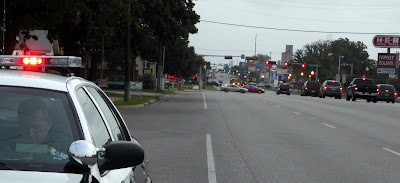


I tell him it is doubtful that I would be able match the speed of the other traffic. But I am going to travel down the street in the travel lane. He is welcome to give me a ticket for any law he thinks I am breaking.

He says well, OK then. Can I see your drivers license? Any ID? (By Texas law, I am required to give any law enforcement officer my name and current address. I am not required to carry ID. An officer can, if he suspects that I am lying to him, detain me until my identity can be established.) He accepts my health insurance card and debit card, both without photos, as evidence enough, and goes to his patrol car to write the ticket.

I then remember my camera is in my bag, and so I haul it out to document the stop. Smile Officer Watson!


So he comes back and asks me to sign the ticket, and I ask what I am signing.

He says, for impeding traffic. I didn't impede traffic, I protest in a conversational tone.

"No, no", he says, "you are just promising to appear on that date." So I ask him what law I violated, and he blinks in surprise. (He thought he had just told me!) So I asked him what part of the law, could he cite it to me?

I figured he would have to cite the section of the transportation code he was accusing me of breaking in the process of writing the ticket, but apparently not. I am sure he is thinking of sec. 545.363 which applies to motor vehicles, not bicycles. But he missed that opportunity to avoid embarrassment. I tried Officer Watson. I am sure that there are many places in the Texas Transportation Code (TTC) that you know better than I do, but I am confident I know my way around the bicycle parts, and you clearly don't.

So we part ways without rancor, and I resume riding centered in the lane.

So I get home and examine the ticket.


I am again surprised that there is no section of the transportation code cited. Do officers just make up the laws they "enforce" as they go along? In this officer's defense, I think he is sincere in his understanding of the law, just sincerely wrong. He will be educated about it soon, it just would have been less expensive for him if he had a little more humility.

Under the heading "VIOLATIONS" it says "CITATION VIO 1: Impeding Traffic" That is all that it says.

Then I discover another surprise. It says "Issued by SGT PILLOW, Badge#620" Huh? Who is that? Does Sgt. Pillow put someone else's name tag on his uniform? I will have to investigate this.

Then, another surprise! The citation is for impeding traffic in the 300 block of West Ennis Avenue! Hah! How could I have been impeding traffic there, when traffic was passing me on the right?

Alright, some observations. This is an example of traffic flow maximization rather than safety promotion. When I see people on bicycles in town, they are invariably scofflaws. The ones who I see riding lawfully seem to me to just be riding that way by chance- should I observe them five minutes later they would be back to their scofflaw ways. Salmon, sidewalk, parking lot ninja and night ninja behavior is the order of the day. These are the practices that are far more hazardous than a cyclist following traffic rules. Yet that lawlessness not an issue for the Ennis police department. Safety is not a priority, smooth traffic flow is.

From the one hundred block of West Ennis Avenue to the end of the three hundred block, it is a very wide single lane road that automobiles routinely share side by side, making it a de-facto two lane road each way. This is to accommodate angled parking.

The rest of West Ennis Avenue is is made up of two narrow lanes in each direction, with the addition of a suicide center left turn lane from the five hundred block to the three thousand block. The question is, can a slow moving vehicle on a multi-lane road impede traffic? Further, the automobile that caused the patrol car to come to a complete stop when it was waiting for a gap in opposing traffic to turn left onto Clay Street, was it impeding traffic?

Yes, they were impeding traffic! In fact, we are "impeded" all the time! We are impeded by school buses loading and unloading children, trains, signal lights, folks preparing to parallel park... you get the drift. We are impeded all the time when we travel about on the public roads. The real question then is, are all those impediments to traffic illegal? Why not? What is illegal impediment of traffic?

TTC Section 545.363; " MINIMUM SPEED REGULATIONS. (a) An operator may not drive so slowly as to impede the normal and reasonable movement of traffic, except when reduced speed is necessary for safe operation or in compliance with law."

"Normal and reasonable movement of traffic." Each word drips with meaning. What is traffic anyway? The TTC defines traffic as: "Sec. 541.301. TRAFFIC. In this subtitle "traffic" means pedestrians, ridden or herded animals, and conveyances, including vehicles and streetcars, singly or together while using a highway for the purposes of travel."

If the traffic this morning was a horse drawn carriage, and not a bicycle, would it be an illegal impedance? Obviously, to say that a vehicle traveling at a speed that is reasonable for that vehicle, but will cause other faster traffic to slow down is an illegal impedence would ban them from operating on public roads. This then would be the effect if the views of Officer Watson/Sgt. Pillow were the proper reflection of the law.

Furthermore, because I was traveling in the right lane, faster traffic was not impeded at all by me, because they had a dedicated passing lane next to the one I was using! Here is the reason I think the TTC is clear on this specific point. The whole of the statute regulating lane position and impeding other traffic is this:

"Sec. 551.101.  RIGHTS AND DUTIES.  (a)  A person operating a bicycle has the rights and duties applicable to a driver operating a vehicle under this subtitle, unless:
(1) a provision of this chapter alters a right or duty; or a right or duty applicable to a driver operating a vehicle cannot by its nature apply to a person operating a bicycle.

Sec. 551.103. OPERATION ON ROADWAY. (a) a person operating a bicycle on a roadway who is moving slower than the other traffic on the roadway shall ride as near as practicable to the right curb or edge of the roadway, unless:
(1)  the person is passing another vehicle moving in the same direction;
(2)  the person is preparing to turn left at an intersection or onto a private road or driveway;
(3)  a condition on or of the roadway, including a fixed or moving object, parked or moving vehicle, pedestrian, animal, or surface hazard prevents the person from safely riding next to the right curb or edge of the roadway; or
(4)  the person is operating a bicycle in an outside lane that is: (A) less than 14 feet in width and does not have a designated bicycle lane adjacent to that lane; or too narrow for a bicycle and a motor vehicle to safely travel side by side.
(c)  Persons operating bicycles on a roadway may ride two abreast. Persons riding two abreast on a laned roadway shall ride in a single lane. Persons riding two abreast may not impede the normal and reasonable flow of traffic on the roadway. Persons may not ride more than two abreast unless they are riding on a part of a roadway set aside for the exclusive operation of bicycles."

So, 551.101 means that a cyclist is "by his nature" unable to keep up with a motor vehicle, so he has no duty to obey the slow vehicle statute when he is traveling at a speed that is reasonable for cyclist.

And in Sec. 551.103 (c) that says two cyclists riding two abreast can be in violation of impeding traffic, but only if a travel lane is wide enough to safely share side-by-side with motorists and a single cyclist. If it is too narrow for a single cyclist to share, then riding two abreast is just as much an impedance as a single cyclist.

So as it stands now, I am charged with impeding traffic. Perhaps they will change it to improper lane position, seeing how there was that lovely shoulder over there I was ignoring.

I must give credit to some folks whose clear thinking and discussions have shaped this blog entry. My thanks to Mighk Wilson, Herman May, Keri Caffrey, AndrewP and fred_dot_u.

***An update! I found Sgt Pillow! I always write the blog and add the photos later. As I was cropping and manipulating my pictures in Picasa 3, I can see there is a person I did not notice during the traffic stop sitting in the passenger seat of the patrol car! Gee whiz!

I think my camera has distorted the features of Officer Watson. He seemed much leaner to me at the time of the stop. My apologies to him for any such distortion of his features.

Tuesday, September 22, 2009

If the Roadway Were Designed Like a Bike Lane

Once upon a time, the Merchants of Ennis complained
that their revenue would not be sustained.
The speeding cars wouldn't come to a stop.
This was causing city commerce to flop.

"Our hamlet is small, but it would mean better pay,
if only more folks would stop and stay.
To swing to the right and parallel park,
it is hard for our customers, even when it's not dark.

"I agree"; said then Mayor, "Parallel parking's a curse."
As he watched merchants money placed in his purse.
"Angled parking is needed to bring customers down,
and bring prosperity back to our town!"

So he called together city staff and his team,
and told them about his prosperity scheme.
Our future is bright,
(My re-election is in sight!)
and this was certainly the key.
He wanted the Engineers of Ennis to "make it be".


The Engineers of Ennis set out to fulfill the wishes of the city staff;
To not do so could cut a career in half.
(If you are a traffic engineer,
this point is very clear:
Take a principled stand-
in a basement you will land.
It sounds awfully callous,
but that's how it is done in Dallas.)


Armed with tape measures and fluorescent paint,
using historical methods now thought of as quaint,
the Ernest Engineers sought out a plan to produce
parking at angles and high sales juice.
They measured the height of the curbs and the width of the street.
They wished West Ennis Avenue had a just few more feet.


"Oh, dear!", exclaimed the Engineers, "Angled parking won't work in this town,
the Customers will be in peril when they back out with traffic around.
Keeping parallel parking is what will keep their cars sound."


"We are doomed!" Shouted the Merchants of Ennis; "Our future is bleak!
Without parking lanes, the customer will stay in his home all week,
for he is afraid to parallel park on the busy West Ennis street!"

"We need more autos at angles!
It must be finagled.
When our customers don't stop
for a bite or a pop,
our books won't balance and they end up in tangles!"


So the City Fathers told the Ernest Engineers,
to make a new plan to avoid any tears.


"I know!' said one of the Ernest Engineers, who thought European ways were neat,
"We can make the portion of West Ennis Avenue that needs angled parking a two lane street."


With new inspiration held firmly in mind,
they set out to make the street a European kind.
The Engineers worked through the day and late into the night.
Alas, they still had no plan when the dawn was in sight.


"It can't be done!" Moaned one. And so it seemed.
Each plan in its turn got creamed.
For every time they moved a line, say from A to B,
another problem would pop up, over at C.


"Over to the east where the railroad tracks sit,
it is too close to downtown, I am at the end of my wit!
Try as I might I can't make it fit."

"There are rules and standards and such.
I have been trained to know that much!
They need us to start many blocks to the east
should we want to comply with State Law, at the least.
But it will cause traffic jams beyond all reason,
even when it is not high shopping season!"


"In Europe, you know", said the first; "they have more reasonable notions when it comes to parking and traffic and such. Let's just erase the right lane and let the drivers do what they want. That's how it works for the Dutch."


"We like it." Said the City Fathers. "For now we can have more autos at angles, which is a good thing.
Our Merchants of Ennis will be so happy they will sing!
(And into our campaign coffers their coin will ring!)"


The Mayor of Ennis pulled aside the chief of police the next day.
"I have a request of you, if I may?
Should a Coveted Customer the law not obey,
would you do us a favor and look away?
It is needed for prosperity, what do you say?"

"The signs will say 'merge left'," said the city DA,
"but we will be silent if drivers of autos do not obey.
Should some poor sap get his car in a wreck,
it will be his fault, his neck.
We shall say "We warned you my dear!"
and so we will always be in the clear."

And so it came to be that both parking at angles and contempt for the law came to downtown Ennis Texas.


The above tale is how I imagine the horrible traffic engineering came about in Ennis Texas. I look at its present configuration, and this is how I assume it had to come about. I have no idea as to the various people who were actually the animating forces, nor their role in it. I doubt I could find out, would you want to be associated with this?

Very few operators of vehicles are able to navigate through westbound West Ennis Avenue without making multiple violations of state traffic laws, but I have never seen them enforced. I am sure that any case brought against a traveler through there would result in a return to parallel parking, for without local knowledge of the situation, breaking the law cannot be avoided if you approach the area in the right lane.

First, between I-45 about a mile to the east, and Waxahachi, ten miles to the west, this street is a four lane boulevard, sometimes with a fifth suicide left turn only center lane. It is choked down to a two lane for these four blocks in all that way. This was done to shoe-horn angled parking into this section. Blatant lawlessness is tolerated to avoid inevitable traffic snarls if both angled parking and obedience to traffic laws were to exist at the same time.


I have blogged about an encounter I had going east through here, and I posted pictures as well. I often changed lanes across a solid white line within a few feet of railroad tracks, and I know now that I shouldn't do so. It is strongly discouraged in Texas to change lanes within 200 feet of a railroad crossing, an intersection or within an intersection. Which is why the newly formed lane begins with a solid white line. Shown here going east:

But it is really fouled up beyond all recognition in the westbound lanes. There is a short series of signaled intersections, an at grade railroad crossing and poor sight-lines caused by the terrain that make the situation unworkable- not that that made any difference!

The sign telling vehicle operators to merge left is beyond the point that they can lawfully do so. The instruction comes after one has already entered the 200 foot railroad zone. Further, the operator cannot see the single lane ahead because of the railroad tracks.


Once you cross the railroad tracks and it is clear your lane ends, you are forced to either merge across a solid wide line, merge in the intersection, or merge after you have entered the angled parking zone.


As you can see. most motorists continue on as if there were two travel lanes available. However, if a vehicle who is parked in a marked parking space edges out and hits you, it is the fault of the person in the "right lane", not the parked operator, because it is often impossible to observe folks driving on the right, as you can also see.

How could a traffic engineer sign off on such monstrosity in good conscience? It is inevitable that injury and property damage will be the result of this attractive nuisance. It seems to me that we could have any two of the three competing interests, at the detriment to the third.

Angled parking and lawful engineering and enforcement, to the detriment of high traffic flow.

Angled parking and high traffic flow at the expense of holding lawful behavior in contempt.

High traffic flow and compliance with the law, without angled parking.

Obviously, this is no big deal for the locals around here. But how is one to lawfully and safely traverse this section of the public road on a bicycle?

If the "wink wink" two lane section is supposed to really be an extra wide lane, where does the cyclist ride in light of our far-to-right laws? In the formerly right lane where parked vehicles can pull out on him? In the "left" lane, the escape route of vehicles passing him on the right?

This section of West Ennis Avenue is what all streets would look like if they were built like most bike lanes are.

Thursday, July 9, 2009

Police Bully

Tuesday evening, I was traveling east on Ennis Street, through our downtown area. There is a two block span of the road that changes from a four-lane to a two lane to accommodate angle parking. The approach looks like this-

 
Posted by Picasa


Posted by Picasa

In spite of the traffic sign ordering through traffic to merge left, and no traffic control lane markers to indicate side by side travel, folks continue as though the the street configuration has not changed. This traffic crime is never enforced, and so scofflaw motoring is the order of the day.

 
Posted by Picasa


Posted by Picasa

I, not wanting to join the lawlessness and be a scofflaw cyclist, obey the law and merge left to travel in the left tire track near the center line because of the hazard presented by automobiles pulling out of the angled parking spaces. At the end of the two blocks, after this intersection and on the approach to the railroad tracks, it becomes a four-lane again.

 
Posted by Picasa


Posted by Picasa

As I approach the railroad tracks, I do a shoulder check, and finding the lane clear, I merge right and continue in the left tire track of the right lane.

Behind me a motorist honks his horn. I ignore him. Traffic flows past me in the next lane. The motorist honks again at me, and then finally decides to roar past me in a huff. I spit in his general direction as he does so. The second photograph below is about where we were at that point.

 
Posted by Picasa


Posted by Picasa

The motorist, in a full size diesel pick-up truck, brakes hard to give me a piece of his mind. (Rather dangerous. He has so little of the stuff!) Of coarse he overshoots as I continue at a steady pace. I then come to a stop at this intersection at the stop line. He pulls up beside me with the passenger window down...


Posted by Picasa

Angry Motorist: "Don't you dare spit on my truck!" (He is leaning forward, screaming past the passenger, a woman about his age.)

Me: "Don't bully law abiding citizens!" (I raise my voice enough so he can hear me, but I refrain from screaming.)

Angry Motorist: "You are not allowed to ride in the middle of the street!"

Me: "Do you just make up the laws as you go along?" (He surprises me by becoming apoplectic at this statement.)

The angry motorist pulls out his wallet and flashes a badge at me.

Angry cop "I am a cop, and you have to get out of the road!"

Me "If I broke the law write me a ticket!"

(He says something here, about me breaking the law or I have to ride differently, I don't remember. He was so wrong I wasn't listening carefully to him. After each statement of his I just repeat my challenge to him to write me a ticket if I were breaking the law. After two more go-rounds like this...)

Angry cop "Do I look like I'm on duty here?" (He was pulling at his shirt to display it to me, indicating that it wasn't a uniform.)

Me "Either write me a ticket or shut up!"

At this point the conversation ended because the light turned green, and we proceeded on our way. He- getting an earful from his passenger- and me, controlling my narrow lane.

Naturally, we think of better things to do or say immediately after it is over. Sadly, I missed a great opportunity here. At the next signal that can barely be seen in the last two pictures, he turned left, which coincidentally was where I was headed on my errand.

He pulled into a gas station, and I went to the store in the next building. As I was about to don my street shoes, it occurred to me that it would be good to find out what police department he worked for, as he could use a little brush-up on Texas bicycle law. As I rushed back to the gas station, I began to hope that I could get his photograph as well!

Alas, I was too late, he was pulling out as I approached. He fled from me, the coward! (Ha! Not really. He seemed to be getting some emphatic advice from his passenger after they saw me riding up. I can only guess who has the power in that relationship!)

Thursday, July 2, 2009

Difficult Left Turns


You are making a right turn from a side street onto a very busy, 40 mph speed limit road (with 50 more common). The road has three lanes of dense traffic in each direction, and about a quarter mile up you need to turn left.

Oh, and about a quarter mile up this busy road is a freeway service road interchange. There are occasional gaps in the traffic but always a chance of a right turn on yield coming off the freeway.

How do you approach such a scenario?


Our gentle reader who authors the excellent blog Beginning Bicycle Commuting has asked the above question.

I would like to see a Google map of the area, but I doubt it would change my advice.

My strategy would be to wait for a gap large enough to to turn directly to the left lane when I entered the street. The key to left turns on high-speed busy roads is to merge early. Way early!

I suppose I would also turn into the center lane and then merge left as soon as I could if there were no gaps big enough to reach the left lane at the start.

I also do not wait for a gap that is so long I will prevent a motorist from braking. I am not going to accelerate to their speed, so no matter how big the traffic gap, they will have to slow down or merge. I just look for a gap big enough that they have the space they need to slow down for me.

Riding in the left-most lane will be confusing to many motorists, but they will merge right to overtake you. It is perfectly within the law to take the left lane when you are preparing to turn left. On high-speed streets, you have to get left early, so early that until you get used to doing it, it seems insanely early. If you wait, you can get trapped in the right lanes and be unable to merge. Merging across early is far less stressful.

While it doesn't show an early merge across multiple lanes, this video does demonstrate merging early and shows the reaction of nearby traffic. And besides, who doesn't like watching Keri ride her bike?


Photos by Fred Oswald © Copyright 2005-2008 LAB Reform. Material may be copied with attribution.

Monday, June 29, 2009

Inane Comments in a Newspaper


I know I shouldn't, but I do anyway.

When a automobile/bicycle collision is reported, I am interested in many aspects of it. What happened, where was the cyclist in the road, why was there a collision? Was there a bike lane, was the cyclist in compliance with the traffic laws? Further though, I am interested in the attitudes, watching for bias by the reporter and the police.

Then, like the fool I am, I click through to the comments. It is mostly always the same. The roads are for cars, it's too dangerous, cars pay for the roads, yadda yadda yadda! And then there is some kid trying to work people up and making hateful threats and the like. I always find that stuff. It never seems to be insightful. Sigh. I just can't help myself.

So today I read about a tragedy in California, and as usual there was a very poor report. I found some gems in the comments that I want to share with you.

Posted by Natalie Bianco, a resident of San Ramon:

I was in the mist of this accident about 2 min behind, I live off of Camino Tassajara on Highland...these accidents are happening to often and the bicyclist need to stop riding on the dangerous roads...there is no room for bike lanes, let alone even wide enough for cars to drive on!!!

I myself have almost had several accidents because the bicyclist take over the road and cars have to slow to dangerous limits while vehicles from other direction on blind turns cannot see the cars or bicycles!!

The bicyclist ride very wide in the roads sometimes taking over the whole lane, with no courtesy to the cars (there is not pull out areas for cars to be able to pass).

These roads have become major commute roads because of the traffic on the 580/680 freeways. I am very sad for the bicyclist but equally as sad for the driver of the car. Bicyclist on Camino Tassajara and many of the other two lane roads are very dangerous let alone on a blind curve at 5:10pm commute time.


Posted by Julie, a resident of the Another Pleasanton neighborhood:

I agree that we should exercise care for cyclists.

I don't agree that we should be expected to drive behind them on a regular road.

It's not always about being selfish or wanting to go "fast". If you have to drive well below the speed limit you create a hazard and besides, it's not fair to have to go extremely slowly on a road or street built for cars.

How would you feel if you were driving on a road with a speed limit of 45 mph and a car in front of you was going at 10 or so mph. I think most of us would go crazy.


Here is what I'm thinking when I read these comments:

I was in the mist of this accident about 2 min behind, I live off of Camino Tassajara on Highland...these accidents are happening to often and the bicyclist need to stop riding on the dangerous roads...there is no room for bike lanes, let alone even wide enough for cars to drive on!!! It is the cyclist's fault because automobile drivers are too incompetent to avoid slow vehicles in their path? The travel lanes are so narrow that they are barely wide enough for a car to fit in, let alone share the lane with another vehicle side-by-side!

I myself have almost had several accidents because the bicyclist take over the road and cars have to slow to dangerous limits while vehicles from other direction on blind turns cannot see the cars or bicycles!! I am stupid enough to attempt passing slow vehicles on blind curves and hills.

The bicyclist ride very wide in the roads sometimes taking over the whole lane, with no courtesy to the cars (there is not pull out areas for cars to be able to pass). Cyclists occupy the lane just like automobiles do.

These roads have become major commute roads because of the traffic on the 580/680 freeways. I am very sad for the bicyclist but equally as sad for the driver of the car. Bicyclist on Camino Tassajara and many of the other two lane roads are very dangerous let alone on a blind curve at 5:10pm commute time. Motorists cannot be expected to avoid running into slow vehicles? The only possible solution would be to get rid of cyclists? If you wish to avoid being delayed by bicycle traffic, you are free to drive your automobile on a different route where bicycles are not allowed. For example, the I-580 or the I-680. Sadly for you, you will be delayed by traffic on either route. Cry me a river.

I agree that we should exercise care for cyclists.

I don't agree that we should be expected to drive behind them on a regular road. What is it about “public” in public road that you don't understand?

It's not always about being selfish or wanting to go "fast". Yes it is. If you have to drive well below the speed limit you create a hazard. Translation: Operators of automobiles are too incompetent to avoid running into slower traffic ahead of them. And besides, it's not fair to have to go extremely slowly on a road or street built for cars. It is an absolutely fair allocation of limited public space! Right of way is distributed on a first come, first use basis. Do you really propose that ROW be determined by one's speed? It is true that public streets are built for automobiles, but they are also built for all of the public to travel on in many different modes: Bicycles, horse drawn carriages, motorcycles, commercial vehicles, pedestrians, and more!

How would you feel if you were driving on a road with a speed limit of 45 mph and a car in front of you was going at 10 or so mph. I think most of us would go crazy. While the designated speed limit is posted at 45 MPH, traffic has made the actual speed limit 10 MPH. Why is a traffic delay produced by a bicycle any different than the traffic delay produced by automobiles? (Say over there on the I-580.) Next time, don't pause at home to drink that second cup of coffee and you will be ahead of that pesky cyclist and queued up behind some other traffic instead. Perhaps you should abandon your expectation that you should always proceed at or near the posted speed limit! It is the vast gulf between your expectations and real world traffic that is driving you crazy.

I feel better now. I just had to get that out of my system.

Thursday, May 28, 2009

Guest Blog: Serge Issakov on advocacy and VC

With Mr. Issakove's permission I am reprinting his thoughts:

I think that it might be effective to further our cause by presenting the safety advice given to motorcyclists with respect to lane positioning, and then to ask the question; "If this is good advice for motorcyclists, why is it not good advice that bicyclists should follow?"

The only plausible and reasonable response is "Because then they are going to get run over from behind, because they are so slow". Once they have articulated this, then they are more likely to seriously consider the evidence against that position.

After that, all that they have left is, "I don't care if it makes cyclists less safe, they need to stay out of the way." Perhaps I'm naive, but I believe most people don't realize that this is, in the end, their position. If they can be made to see that they are holding to such a callus position, we will have an opportunity to change it.

Most people seem to honestly believe that the reason they are justified in believing that bicyclists should be out of the way is because bicyclists are unnecessarily endangering themselves. So, one way or the other, we need to convey that bicycling "out of the way" is often more dangerous than being "in the way".

That's why I think it's important to emphasize the dangers of riding "out of the way". Presenting the safety advice given to motorcyclists, and then asking your audience to consider the reasoning behind that advice. Why shouldn't these principals also apply to bicyclists? They do apply to operating a bicycle, and ought to be applied to our craft.

Serge